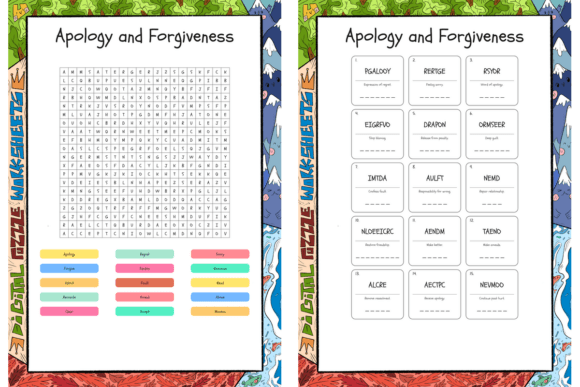
Cultivating Empathy Through Play: The Rise of Apology and Forgiveness Word Search Puzzles
In the evolving landscape of educational resources and child development tools, there is a distinct shift toward activities that blend cognitive stimulation with emotional intelligence. Parents, educators, and content creators are increasingly seeking solutions that do more than just entertain; they want resources that instill values. At the forefront of this movement is the Apology and Forgiveness Word Search Puzzle, a specialized learning tool designed to engage children of varying ages while teaching critical social-emotional skills. This handcrafted resource represents a convergence of traditional puzzle mechanics and modern pedagogical needs, offering a unique pathway to nurture language skills alongside moral values.
Redefining Educational Engagement for the Modern Child
The traditional approach to teaching concepts like remorse, reconciliation, and empathy often relied on abstract discussions or heavy-handed lectures. However, contemporary understanding of child psychology suggests that interactive, low-stakes environments yield better retention and behavioral adoption. The Apology and Forgiveness Word Search Puzzle fits perfectly into this paradigm. By transforming complex emotional vocabulary into a game, it lowers the barrier to entry for difficult conversations.
This activity is not merely a pastime; it is a structured exercise in vocabulary acquisition and pattern recognition. When a child searches for words like "regret," "understand," "kindness," or "peace" within a grid, they are subconsciously associating these terms with positive engagement. The brain begins to map these concepts not as scolding mechanisms, but as integral parts of a fun, stimulating challenge. For professionals in the education sector, this represents a significant opportunity to integrate social-emotional learning (SEL) into daily routines without disrupting academic flow.
A Multi-Faceted Learning Experience
What sets this specific resource apart is its versatility. It is rarely just a word search. To maximize engagement across different developmental stages, the Apology and Forgiveness Word Search Puzzle often incorporates additional formats such as word scrambles and crosswords. This multi-modal approach ensures that the activity remains fresh and challenging for diverse age groups.
- Word Searches: Ideal for younger children, focusing on visual scanning and basic spelling recognition.
- Word Scrambles: A step up in difficulty, requiring children to unscramble letters to form meaningful words related to conflict resolution, thereby reinforcing orthography.
- Crossword Puzzles: Perfect for older children, utilizing clues that require them to define the concept before finding the answer, deepening their conceptual understanding.
This layered design allows parents and teachers to scaffold learning effectively. A preschooler might enjoy the visual hunt of the word search, while a middle-schooler tackles the semantic challenges of the crossword. Such adaptability makes the tool a staple in both home and school settings, catering to the wide spectrum of cognitive abilities found in any classroom or family unit.
Aligning with Broader Industry Trends in EdTech and Parenting
The popularity of value-driven puzzles like the Apology and Forgiveness Word Search Puzzle is not an isolated phenomenon. It reflects broader trends in the education technology (EdTech) and parenting industries. There is a growing consumer demand for "screen-free" digital alternatives and printable resources that offer tangible benefits. In an era dominated by passive screen consumption, parents are actively seeking activities that promote active problem-solving and critical thinking.
Furthermore, the focus on mental health and emotional well-being has permeated every aspect of society, including early childhood education. Schools are under increasing pressure to address bullying, conflict resolution, and emotional regulation. Traditional curricula often struggle to cover these soft skills comprehensively. Resources that merge entertainment with moral instruction fill this gap efficiently. The Apology and Forgiveness Word Search Puzzle serves as a practical implementation of the "whole-child" education philosophy, which advocates for nurturing the emotional and social dimensions of a child's development alongside their academic growth.
For entrepreneurs and creators in the digital product space, this trend highlights a lucrative niche. The market is moving away from generic worksheets toward thematic, high-quality content that addresses specific life skills. A well-designed puzzle set on forgiveness is not just a PDF download; it is a conversation starter, a therapeutic tool, and a community-building resource. It aligns with the lifestyle trend of mindful parenting, where every interaction and activity is viewed as an opportunity to guide a child toward becoming a compassionate adult.
Why Attention is Shifting to Moral Vocabulary Games
Why are people paying attention to this specific type of activity now? The answer lies in the changing nature of social interactions and the complexities of modern childhood. Children today navigate a world filled with digital communication, where the nuances of tone and body language are often lost. Teaching the vocabulary of apology and forgiveness becomes even more crucial when face-to-face interactions are sometimes mediated through screens.
By engaging with an Apology and Forgiveness Word Search Puzzle, children build a lexicon of empathy. They learn that saying "I'm sorry" is not just a reflex but involves understanding "remorse," "acceptance," and "healing." This linguistic foundation is essential for navigating peer relationships and resolving conflicts constructively. Educators observe that children who possess a richer vocabulary regarding emotions are better equipped to articulate their feelings and understand the perspectives of others.
Moreover, the workflow of modern families has changed. With busy schedules and dual-income households, parents need efficient ways to reinforce values. An activity that can be completed in 15 minutes, either at the dinner table or during a quiet afternoon, offers a high return on investment. It requires minimal preparation yet delivers significant developmental benefits. This efficiency makes it a preferred choice for time-constrained caregivers who still prioritize character building.
Practical Applications in Home and School Environments
The utility of the Apology and Forgiveness Word Search Puzzle extends beyond theory into practical application. In a classroom setting, teachers can use these puzzles as icebreakers for lessons on citizenship or as calming activities after a conflict occurs. Instead of punitive measures, a teacher might invite students to work together on a forgiveness-themed puzzle, fostering a sense of unity and shared purpose. The collaborative nature of solving a crossword or scrambling words encourages teamwork and peer support.
At home, the dynamic shifts slightly but remains equally impactful. Parents can use the activity as a neutral ground to discuss recent events. If a sibling dispute has occurred, working through the puzzle together can serve as a non-threatening way to revisit the concepts of making amends. The act of finding the word "forgive" side-by-side can subtly reinforce the desire to let go of grudges. It transforms a potentially tense moment into a constructive learning experience.
Consider a scenario where a child struggles to apologize sincerely. A parent might pull out the puzzle and ask, "Can you find the word that means 'feeling bad about what you did'?" Once the child finds "guilt" or "regret," the parent can gently explain how acknowledging those feelings is the first step toward a genuine apology. This method uses the puzzle as a bridge to deeper understanding, avoiding direct confrontation while still addressing the core issue.
Fostering Cognitive Growth and Problem-Solving
Beyond the moral lessons, the Apology and Forgiveness Word Search Puzzle is a robust tool for cognitive development. The process of searching for words in a grid enhances visual discrimination and spatial awareness. It trains the brain to recognize patterns and scan information systematically—skills that are transferable to reading comprehension and mathematical reasoning.
When the activity includes word scrambles or crosswords, the cognitive load increases. Children must hold multiple pieces of information in their working memory, manipulate letter sequences, and deduce answers based on contextual clues. These are foundational executive functions that are critical for academic success. By wrapping these cognitive challenges in a theme of kindness and reconciliation, the activity ensures that the brain is exercised while the heart is engaged.
Furthermore, the satisfaction of completing a puzzle releases dopamine, creating a positive feedback loop. Children associate the concepts of apology and forgiveness with the feeling of accomplishment. This psychological association is powerful; it helps reframe these actions from being perceived as burdensome obligations to being rewarding achievements.
The Future of Value-Based Educational Tools
As we look toward the future, the integration of moral education into gamified learning tools will likely become standard practice. The Apology and Forgiveness Word Search Puzzle exemplifies this trajectory. It demonstrates that education does not have to be dry or purely academic to be effective. By merging the timeless human need for connection and understanding with the universal appeal of puzzles, creators are producing resources that resonate deeply with modern audiences.
For marketers and business owners in the education sector, the lesson is clear: consumers are looking for products that solve real-life problems. A worksheet that teaches math is useful, but a worksheet that teaches math while also helping a child manage their emotions is indispensable. The demand for such holistic resources is driven by a generation of parents and educators who understand that success in life is defined not just by test scores, but by character, empathy, and the ability to maintain healthy relationships.
The Apology and Forgiveness Word Search Puzzle stands as a testament to the power of thoughtful design. It is a tool that respects the intelligence of the child while guiding them toward higher moral ground. Whether used in a bustling classroom or a quiet living room, it serves as a reminder that the most important lessons are often the ones we learn together, one word at a time. As the industry continues to evolve, resources that seamlessly blend cognitive challenge with emotional growth will remain at the forefront of educational innovation, shaping a generation that is not only smart but also kind.