Stationery 3D Icons: Elevating Visual Communication with Playful Depth
In the crowded landscape of digital design, flat graphics often struggle to capture attention. As user interfaces and marketing materials evolve, there is a distinct shift toward depth, texture, and tactile realism. This is where Stationery 3D Icons become an essential asset for designers, educators, and business owners. These are not merely static images; they are high-resolution, three-dimensional representations of office supplies, school essentials, and creative workspace items. By integrating these assets into your workflow, you bridge the gap between abstract digital concepts and the physical tools people recognize and trust.
The appeal of this specific icon pack lies in its balance of playful shapes and polished textures. Unlike generic clip art that can feel sterile or outdated, these icons possess a dimensional quality that adds weight and credibility to a presentation or application. Whether you are building a productivity app, designing a curriculum for an education platform, or refreshing your company's branding, the visual language you choose sets the tone for the entire experience. Using high-quality 3D stationery elements signals professionalism while maintaining an approachable, human-centric aesthetic.
Understanding the Asset Structure and Technical Specifications
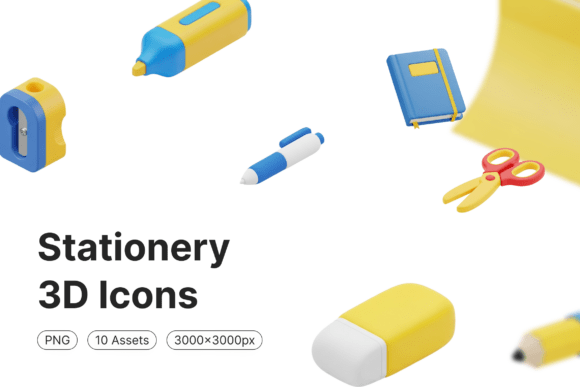
Before integrating any new visual resource into a project, it is critical to understand the technical foundation. The Stationery 3D Icons pack provided by RRGraph Design offers a robust set of ten objects, each meticulously crafted to ensure versatility across different media. The primary deliverables include high-resolution PNG files and OBJ model files. This dual-format availability is a significant advantage for professionals who need flexibility in their execution.
The PNG files are rendered at a resolution of 3000 x 3000 pixels. This high resolution ensures that the icons remain crisp and clear even when scaled up for large format printing, such as banners, posters, or trade show displays. In a digital context, this means the icons will look sharp on retina displays and 4K monitors without pixelation. For web developers and UI designers, the transparency inherent in PNGs allows for seamless layering over various background colors and patterns, ensuring the icons blend naturally into the existing interface.
However, the inclusion of OBJ files elevates this pack from a simple image library to a true 3D modeling resource. OBJ is a standard geometry definition file format used in 3D computer graphics. Having access to the source models allows advanced users to import the stationery items into software like Blender, Cinema 4D, or Maya. This opens up possibilities for custom lighting, camera angles, and animation. If a project requires a specific perspective or a unique interaction with light that the pre-rendered PNGs do not provide, the OBJ files serve as the raw material for creating bespoke visuals without starting from scratch.
Strategic Integration Across Professional Workflows
The utility of Stationery 3D Icons extends far beyond simple decoration. They play a functional role in various stages of the creative and business process. In the planning phase of a new product launch, for example, these icons can be used in mood boards and wireframes to establish a visual direction. A planner design team might use these icons to visualize how a digital planner will interact with physical desk setups, creating a cohesive narrative for potential users.
During the execution phase, these assets streamline the design process. Instead of spending hours modeling a realistic stapler, notebook, or pen from scratch, designers can drop the pre-made 3D icons directly into their composition. This efficiency is crucial for freelancers and small agencies operating under tight deadlines. It allows the team to focus on layout, typography, and color theory rather than getting bogged down in the minutiae of asset creation. The polished textures included in the pack reduce the need for extensive post-processing, saving valuable time in the rendering pipeline.
Post-launch, these icons serve as consistent brand markers. In email newsletters, social media graphics, and internal documentation, using the same set of stylized stationery items reinforces brand identity. Consistency in visual assets helps audiences quickly recognize content as belonging to a specific organization. For education platforms, this consistency is particularly important. Students and teachers develop a familiarity with the visual cues, which can improve navigation and engagement within learning management systems.
Use Cases in Education, Productivity, and Branding
The versatility of this icon pack makes it suitable for a wide range of industries. In the education sector, the playful yet professional nature of the icons resonates well with both younger students and adult learners. An e-learning course on project management could use a 3D clipboard icon to represent task lists, while a math tutorial might utilize a ruler or protractor icon to denote measurement sections. The 3D aspect adds a layer of engagement that flat icons often lack, making the learning environment feel more dynamic and interactive.
For productivity apps and planners, the visual representation of office supplies serves as a psychological anchor. When users see a realistic-looking calendar, sticky note, or coffee cup, it triggers associations with their own physical workspace. This connection can enhance the user experience, making the digital tool feel more intuitive. App developers can use these icons for feature toggles, dashboard widgets, or notification badges. The high resolution ensures that these small UI elements remain legible and attractive on mobile devices.
In the realm of office branding and corporate communications, these icons help modernize traditional aesthetics. Many businesses still rely on dated, two-dimensional graphics that fail to reflect their innovative spirit. By adopting Stationery 3D Icons, companies can signal that they are forward-thinking and detail-oriented. These assets work exceptionally well in pitch decks, annual reports, and client presentations. A slide featuring a 3D stack of papers or a sleek pen can break up dense text and guide the viewer's eye through the narrative flow of the presentation.
Optimizing Workflow and Compatibility
To get the most out of this asset pack, it is important to consider compatibility and organization within your existing software suite. The PNG files are universally compatible with graphic design tools like Adobe Photoshop, Illustrator, Canva, and Figma. When importing them, ensure that the document resolution matches the output requirements to maintain the integrity of the 3000 x 3000 px source. For web projects, it is advisable to optimize the PNGs for file size without sacrificing visual quality, ensuring fast load times for end-users.
For those utilizing the OBJ files, the workflow involves importing the models into a 3D rendering engine. Here, the "ready to render" characteristic of the pack becomes a major time-saver. The models come with appropriate UV mapping and textures, meaning they are ready for immediate lighting and shading adjustments. Designers should test the models in their specific rendering environment to ensure that the scale and proportions align with other assets in the scene. This step is crucial for maintaining visual consistency when mixing these icons with custom-created 3D elements.
Organization is another key factor in long-term usability. Since the pack includes only ten objects, it is manageable, but integrating them into a larger asset library requires a systematic approach. Tagging the files with relevant keywords such as "office," "school," "planner," and "productivity" within your digital asset management system will make them easily retrievable for future projects. This practice ensures that the investment in high-quality visuals pays dividends over time, allowing teams to reuse assets efficiently across multiple campaigns and products.
Quality Control and Long-Term Value
When selecting visual assets, quality control is paramount. The Stationery 3D Icons pack stands out due to the attention to detail in the textures and shapes. Polished surfaces reflect light realistically, adding a sense of premium quality to the final design. However, it is important to remember that the mockup preview is not included in the package. Users must create their own contexts or backgrounds to showcase these icons effectively. This requirement actually encourages creativity, forcing designers to think critically about how these elements fit into their specific brand ecosystem.
The value of these assets also lies in their longevity. Trends in graphic design change, but the fundamental need for recognizable office and school symbols remains constant. Because these icons are rendered in 3D, they have a timeless quality that resists becoming "dated" as quickly as flat design trends might. Investing in a versatile, high-resolution pack like this one ensures that your visual library remains relevant for years. It reduces the need for frequent redesigns and allows for a consistent visual language across all touchpoints.
RRGraph Design has established a reputation for helping over 1,000 global companies meet their presentation needs, and this icon pack reflects that commitment to customer satisfaction. The focus on practical, high-quality resources demonstrates an understanding of what professionals truly need: assets that work seamlessly within real-world workflows. By prioritizing usability, resolution, and format flexibility, this pack empowers creators to execute their vision with confidence.
Final Thoughts on Implementation
Integrating Stationery 3D Icons into your design process is a strategic decision that impacts both the aesthetics and the functionality of your projects. From the initial planning stages to the final delivery, these assets offer a reliable way to communicate ideas clearly and engagingly. Whether you are an educator creating a lesson plan, a marketer launching a campaign, or a developer building a productivity tool, the right visual elements can make all the difference.
The combination of high-resolution PNGs for immediate use and editable OBJ files for customization provides a comprehensive solution for diverse needs. By leveraging these tools, you can enhance the perceived value of your work, improve user engagement, and maintain a cohesive brand identity. As you move forward with your next project, consider how these playful yet professional 3D elements can transform your visual communication strategy. The result is a more polished, effective, and memorable outcome that resonates with your audience.