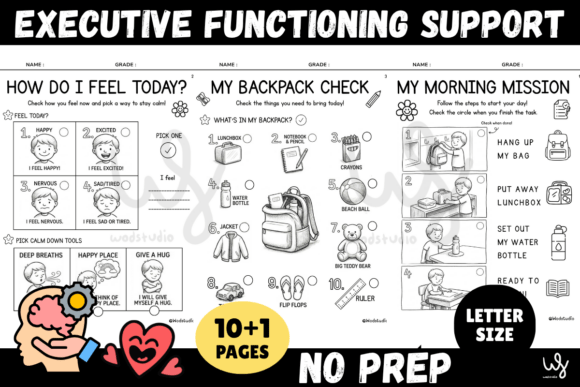
Executive Function Support Activity Pack: Building Life Skills for Young Learners
Helping children develop strong executive functioning skills early sets a foundation for lifelong success. The Executive Function Support Activity Pack offers educators and caregivers a practical, no-prep solution to guide young learners through essential routines and emotional regulation. Designed with early learners in mind, this 5-page PDF resource simplifies daily transitions and supports the development of organization, self-awareness, and task completion.
Why Executive Functioning Matters in Early Education
Executive functioning skills—like planning, organizing, and managing emotions—are crucial for academic and personal growth. Children who struggle with these skills may have difficulty starting tasks, staying focused, or navigating social situations. The Executive Function Support Activity Pack addresses these challenges with visual tools that make routines predictable and manageable.
Supporting Consistent Morning Routines
Starting the school day smoothly can set a positive tone for learning. The “My Morning Mission” worksheet provides a step-by-step visual checklist that guides students through their morning routine. From unpacking backpacks to finding their seat, this tool helps children build independence and confidence right from the start of the day.
Emotional Awareness and Regulation
Emotional regulation is a key component of executive functioning. The “How Do I Feel Today” worksheet encourages students to identify and express their emotions. With visual cues and calming strategy options, it gives children a safe space to check in with themselves and practice self-management techniques, which are especially valuable in high-energy or stressful moments.
How the Activity Pack Enhances Classroom Engagement
Visual learning tools are particularly effective for young learners, especially those with learning differences or attention challenges. The hand-drawn illustrations and clear layouts in the Executive Function Support Activity Pack make the activities engaging and accessible. These worksheets are designed to be completed independently, freeing educators to focus on individualized support and classroom instruction.
Exploring the Learning Environment
The “Classroom Map Detective” activity turns environmental navigation into a fun scavenger hunt. This worksheet encourages students to explore their surroundings, locate important areas, and build spatial awareness. It’s especially useful in the early weeks of school or for students adjusting to a new classroom setting.
Organizing Daily Essentials
Staying organized is a skill that benefits students throughout their academic journey. The “My Backpack Checklist” worksheet helps children pack and unpack essential items each day. By reinforcing routine and responsibility, this tool reduces lost items and last-minute scrambles, making mornings and afternoons more efficient for both students and teachers.
Smooth Transitions at the End of the Day
Ending the school day with structure helps children mentally transition from school to home. The “My End-of-Day Countdown” worksheet breaks down the closing routine into clear, manageable steps. This visual guide supports students in wrapping up activities, packing up belongings, and preparing for the next day—all while reinforcing a sense of accomplishment and readiness.
Who Benefits Most from This Resource
Educators in special education (SPED) settings, early childhood classrooms, and social-emotional learning (SEL) programs will find this pack particularly valuable. It’s also a helpful tool for parents and caregivers supporting children with attention challenges, autism spectrum disorder, or sensory processing differences. The simplicity and adaptability of the worksheets make them suitable for a wide range of learners and environments.
Practical Implementation and Classroom Use
One of the standout features of the Executive Function Support Activity Pack is its ease of use. The no-prep design means educators can simply print and go. Each worksheet is formatted for standard 8.5 x 11-inch paper and integrates seamlessly into morning work, transition periods, or end-of-day routines. The compact 5-page format makes it easy to incorporate into existing lesson plans without overwhelming students or teachers.
Customization and Flexibility
While the pack is designed for early learners, many educators find that slight modifications allow the tools to be used across a broader age range. For example, “How Do I Feel Today” can be adapted to include more nuanced emotional vocabulary for older students. Similarly, the “Classroom Map Detective” can be expanded to include more complex directions or classroom responsibilities as students grow more confident.
Realistic Expectations and Limitations
While the Executive Function Support Activity Pack offers valuable tools, it’s important to recognize that no single resource can address every child’s needs. Some students may require additional support, such as individualized behavior plans or one-on-one coaching. The pack works best as part of a broader strategy that includes consistent routines, positive reinforcement, and open communication between educators and families.
Considerations for Educators and Caregivers
When introducing these tools, it’s helpful to model their use and provide guided practice. Over time, students can take more ownership of the routines, using the worksheets as independent references. Educators may also want to pair the pack with other SEL resources or life skills curricula to create a more comprehensive learning experience.
Supporting Long-Term Skill Development
The routines and strategies introduced in the Executive Function Support Activity Pack are designed to build habits that extend beyond the classroom. By reinforcing organization, emotional awareness, and task completion, this resource supports the development of skills that children will use throughout school and into adulthood. Whether used in a structured classroom setting or at home, the pack offers a meaningful way to empower young learners.