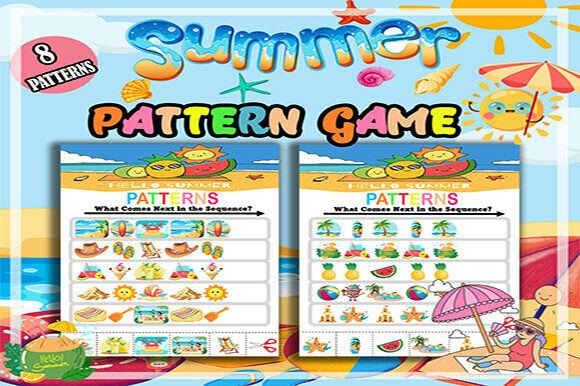
Summer Beach Finish the Pattern Activity
As the school year winds down, maintaining student engagement while reinforcing critical early math skills can feel like a balancing act. The Summer Beach Finish the Pattern activity offers a vibrant solution that bridges the gap between end-of-year review and meaningful learning. Designed specifically for preschoolers and kindergarteners, this resource transforms abstract mathematical concepts into a tangible, hands-on experience using familiar summer imagery. By incorporating elements like suns, beach balls, ice cream cones, and flip-flops, educators create an inviting environment where pattern recognition feels less like a test and more like play.
The core value of this activity lies in its ability to scaffold learning through visual sequencing. Children are not simply matching images; they are analyzing relationships between objects to predict what comes next. This process builds the foundational logic required for future algebraic thinking. Whether you are running a summer school program, managing classroom centers, or preparing take-home packets for families, this no-prep resource ensures that learning remains consistent, even as the calendar shifts toward vacation mode.
Building Mathematical Foundations Through Play
Pattern recognition is one of the earliest and most significant indicators of mathematical proficiency. When children engage with the Summer Beach Finish the Pattern worksheets, they are actively practicing several distinct cognitive skills simultaneously. The activity introduces four primary pattern structures: AB, AAB, ABB, and ABC. Each level presents a unique challenge that grows with the child's developing abilities.
In an AB pattern, such as "sun, cloud, sun, cloud," the learner identifies a simple alternating relationship. This is often the entry point for young learners. As confidence grows, the AAB pattern ("ice cream, ice cream, cone, ice cream, ice cream, cone") requires the child to hold two items in their working memory before identifying the third. The ABB structure flips this dynamic, demanding a shift in attention, while the ABC pattern introduces a three-element cycle that tests sustained focus and complex sequencing.
Beyond the math itself, the physical act of completing these patterns supports fine motor development. Depending on how the activity is implemented, children may cut out image strips, glue them into place, or use manipulatives to cover printed spots. These actions refine hand-eye coordination and strengthen the small muscles in the fingers and hands—skills that are directly transferable to handwriting and other precision tasks later in their education.
Adapting the Activity for Diverse Learning Environments
One of the greatest strengths of the Summer Beach Finish the Pattern resource is its versatility. It is not a one-size-fits-all tool but rather a flexible framework that can be adapted to suit various educational settings and individual student needs. For classroom teachers, this activity serves as an excellent anchor for math stations or morning work routines. Because it requires minimal preparation, it allows educators to set up independent work quickly, freeing them to provide targeted support to students who need it most.
Homeschooling parents will find this resource particularly valuable for maintaining structure during the summer months. It provides a clear objective for daily lessons without requiring extensive material gathering. Simply print the pages, gather some scissors and glue, and you have a complete lesson plan. For special education settings, the high-contrast, colorful imagery aids in visual discrimination, making the task accessible to children who might struggle with text-heavy instructions. The concrete nature of the summer objects helps ground abstract concepts in reality.
Consider how you might extend the activity to deepen the learning experience. Instead of just gluing the correct answer, encourage students to verbalize the pattern aloud as they work. Ask questions like, "What do you see coming next?" or "Why did you choose the flip-flop here?" This verbalization reinforces vocabulary building and strengthens the connection between the visual cue and the spoken language. You can also turn the activity into a collaborative game where pairs of students must agree on the next item in the sequence before placing it.
Creative Variations and Project Ideas
To keep the activity fresh and engaging, consider introducing variations that challenge students to think beyond the printed page. One effective approach is to move from paper-based completion to real-world application. Create a "pattern hunt" around the classroom or home, asking children to find examples of AB or AAB patterns in their surroundings. They might notice the alternating colors of a rug, the repeating shape of tiles, or the rhythm of clapping games.
Another creative extension involves having students design their own patterns. Provide blank strips of paper and a selection of summer-themed stickers or cutouts. Challenge them to create a pattern that follows a specific rule, such as "make a long ABB pattern using only beach items." This shifts the role of the learner from consumer to creator, fostering higher-order thinking skills. Once they have designed their pattern, they can trade with a partner to solve each other's sequences.
For a digital twist, if you have access to tablets or interactive whiteboards, the concept can be translated into a virtual drag-and-drop exercise. This is particularly useful for hybrid learning environments or when aiming to reduce paper waste. The visual logic remains the same, but the interface changes to meet the needs of a tech-integrated curriculum. Regardless of the format, the goal remains consistent: to make the identification and continuation of patterns an intuitive and enjoyable process.
Ensuring Consistency and Clarity in Instruction
When implementing any new activity, clarity is key to ensuring success. To maximize the effectiveness of the Summer Beach Finish the Pattern, establish clear expectations before beginning. Demonstrate the first problem together as a class, thinking aloud as you identify the rule and select the correct image. This modeling helps students understand the process before they attempt it independently.
Organize your materials logically to prevent frustration. If using cut-and-paste methods, pre-cut the shapes for younger learners or those with developing motor skills, allowing them to focus entirely on the pattern logic. For older kindergarten students, leaving the shapes attached to the worksheet encourages practice with cutting along lines. Consistency in routine helps build confidence; if students know exactly what is expected of them, they are more likely to engage deeply with the content.
Finally, remember that the ultimate goal is not just to finish the worksheet but to internalize the skill. Celebrate effort and reasoning over speed. If a child makes a mistake, guide them to discover the error by asking, "Does this match the rule we found earlier?" This supportive feedback loop encourages resilience and critical thinking, turning every interaction into a meaningful learning opportunity.
By integrating the Summer Beach Finish the Pattern into your summer curriculum, you provide a bridge between fun and function. It is a practical tool that respects the developmental needs of young learners while delivering essential academic benefits. Whether used in a bustling classroom, a quiet homeschool setting, or a specialized intervention session, this activity proves that learning can be colorful, engaging, and deeply impactful all at once.