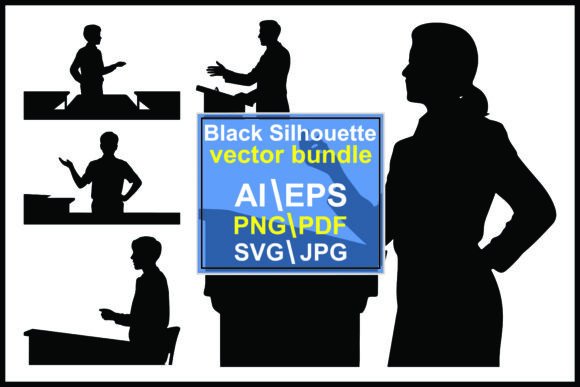
Silhouettes People Speaking at Podiums: A Practical Guide to Versatile Presentation Graphics
In the realm of visual communication, the ability to convey authority, engagement, and context without relying on specific facial features is a distinct advantage. This is where Silhouettes People Speaking at Podiums become an essential resource for designers, educators, and business professionals. These graphics offer a universal language of public speaking, capturing the essence of a lecture, debate, or corporate presentation through form and gesture rather than detail. Whether you are creating a slide deck for a board meeting, designing educational materials for a classroom, or illustrating a political campaign poster, understanding the utility and limitations of these silhouette assets is crucial for making informed design decisions.
The Distinct Value of Silhouette Graphics in Professional Design
Silhouettes People Speaking at Podiums differ significantly from full-color illustrations or photographic stock images. Their primary distinction lies in their abstraction. By reducing complex human figures to solid shapes against a white background, these assets strip away distracting details such as clothing brands, skin tones, or specific identities. This neutrality allows the viewer to focus entirely on the action—the speech itself—and the context provided by the podium or desk.
This style is particularly effective when the subject matter requires a sense of universality. In a global conference setting, a photograph might inadvertently exclude certain demographics or feel too specific to a particular culture. A silhouette, however, represents "the speaker" in the most general sense. It captures the dynamic of public speaking, whether it is a politician addressing a crowd, a teacher explaining a concept, or an executive delivering quarterly results. The gesture of a hand pointing or talking becomes the focal point, communicating confidence and direction without the noise of unnecessary visual data.
Furthermore, the isolated nature of these designs on a white background offers unparalleled flexibility. Unlike photos that require color grading to match a brand palette, silhouettes can be instantly recolored to fit any theme. They serve as a foundational element that integrates seamlessly into complex layouts, ensuring that the visual hierarchy remains intact while supporting the core message of the presentation.
Evaluating Format Options: Vector vs. Raster Assets
When sourcing Silhouettes People Speaking at Podiums, one of the most critical decisions involves the file format. A comprehensive bundle typically includes multiple formats such as JPG, PNG, AI, EPS, SVG, and PDF, all compressed into a single zip file. Understanding the tradeoffs between these formats is vital for ensuring the asset performs correctly across different mediums.
- Raster Formats (JPG, PNG): These are best suited for web use, social media posts, or presentations where high-resolution printing is not required. PNG files, in particular, are valuable because they support transparency, allowing the silhouette to sit cleanly over colored backgrounds without a white box around them. However, raster images lose quality when scaled up, which can result in pixelation if used for large banners or billboards.
- Vector Formats (AI, EPS, SVG): For professional print work or large-scale digital displays, vector formats are superior. Files like AI (Adobe Illustrator) and EPS (Encapsulated PostScript) allow for infinite scaling without any loss of resolution. This makes them ideal for scenarios where the speaker needs to appear small in a thumbnail but large on a conference backdrop. SVG is the web-standard vector format, ensuring crisp edges on responsive websites.
- PDF: Often overlooked, PDFs provide a reliable way to share vector data with clients or printers who may not have access to Adobe Creative Cloud software, ensuring the integrity of the design remains consistent.
Having access to a bundle containing all these types ensures that you are not locked into a single workflow. If you need to extract the files using tools like WinZip or WinRAR, having the variety within that archive means you can choose the right tool for the job at every stage of your project.
Comparing Silhouettes to Photorealistic and Illustrative Alternatives
While Silhouettes People Speaking at Podiums offer significant advantages, they are not the only option available. Comparing them to photorealistic stock photography or detailed cartoon illustrations reveals specific situations where each excels.
Photography provides emotional depth and realism. If a project requires showing empathy, specific reactions, or a genuine connection between a lawyer and a jury, a photo is often more effective. However, photos come with licensing complexities, potential model release issues, and rigid styling that can clash with a brand's aesthetic. They also date quickly; fashion trends change, and a photo taken five years ago may look outdated today.
Detailed Illustrations offer a middle ground, providing character and style without the constraints of reality. They are excellent for storytelling and branding that relies on a unique artistic voice. Yet, they can be time-consuming to customize and may not blend as easily with corporate templates as a clean silhouette does.
In contrast, Silhouettes People Speaking at Podiums excel in clarity and speed. They are the pragmatic choice when the goal is to illustrate a concept—such as a debate stage, a classroom discussion, or a business meeting—without drawing attention to the illustration itself. They act as functional icons that guide the eye rather than distract it. For instance, in a conference agenda, a silhouette of a person at a desk clearly indicates a panel discussion without requiring the audience to process complex visual details.
Decision Factors: When to Choose Silhouettes
Determining whether Silhouettes People Speaking at Podiums are the right choice for your project depends on several key factors. Consider the following scenarios where this style is likely the optimal solution:
1. Brand Consistency and Minimalism
If your organization adheres to a minimalist design philosophy, silhouettes align perfectly. They reduce visual clutter and maintain a clean, professional look. Because they lack intricate details, they do not compete with typography or other graphical elements, ensuring that your text regarding communication strategies or education goals remains the priority.
2. Scalability Requirements
Projects that require the same image to be used across various sizes—from a mobile app icon to a large event banner—benefit immensely from the vector capabilities of these bundles. The ability to scale a man or woman speaking without losing definition is a practical necessity that raster images cannot meet.
3. Universal Representation
When the subject is the role rather than the individual, silhouettes are unmatched. Whether depicting a politician, a teacher, or an executive, the silhouette removes bias and focuses on the function of the role. This is particularly useful in meetings or discussions involving diverse audiences where inclusivity is paramount.
4. Budget and Time Constraints
Commissioning custom illustrations or purchasing expensive photo licenses can be costly and time-consuming. A versatile bundle of silhouettes offers a cost-effective alternative. With the ability to use the designs for any purpose, including commercial projects, the return on investment is immediate. The inclusion of multiple formats in one zip file streamlines the workflow, eliminating the need to search for different versions of the same asset.
Limitations and Strategic Tradeoffs
Despite their versatility, there are scenarios where Silhouettes People Speaking at Podiums may not be the best fit. One limitation is the lack of emotional nuance. A silhouette cannot convey a subtle smile, a furrowed brow, or a tearful expression. If your narrative relies heavily on emotional resonance or specific character development, a more detailed approach is necessary.
Additionally, silhouettes rely heavily on context. Without accompanying text or surrounding design elements, a silhouette of a person at a podium could be ambiguous. Is it a wedding toast? A protest? A graduation speech? The user must provide the context through layout and copy. Therefore, these assets work best as part of a cohesive design system rather than standalone hero images.
Another consideration is the technical skill required to utilize vector formats effectively. While JPG and PNG files are plug-and-play, editing AI or EPS files requires familiarity with vector software like Adobe Illustrator. Users who lack this expertise may find the advanced formats less immediately useful, though the included PNGs usually suffice for standard office tasks.
Practical Application Across Industries
The utility of Silhouettes People Speaking at Podiums extends across various sectors, demonstrating their adaptability. In education, teachers can use these graphics to create engaging lesson plans about civic duty or leadership. In the legal field, lawyers can incorporate them into client presentations to visualize court proceedings or negotiation dynamics. In the corporate world, executives use them to illustrate strategic planning sessions or annual reports.
For example, a non-profit organization advocating for free speech might use a silhouette of a person gesturing emphatically at a debate stage to symbolize the power of voice. Conversely, a tech company launching a new collaboration tool might use a silhouette of a group at a desk to represent teamwork and discussion. The simplicity of the design allows it to transcend industry boundaries, serving as a flexible tool for visual storytelling.
Conclusion: Making an Informed Choice
Selecting the right visual assets is a balance between aesthetic preference, functional requirements, and budgetary constraints. Silhouettes People Speaking at Podiums offer a robust solution for those seeking clarity, scalability, and neutrality in their designs. By providing a collection of formats ranging from web-ready PNGs to scalable vectors, these bundles empower users to tackle a wide array of projects efficiently.
While they may not replace the emotional impact of photography or the charm of detailed illustration, their strength lies in their ability to communicate concepts quickly and universally. For professionals aged 20–50 navigating the complexities of modern communication, understanding when and how to deploy these silhouettes can significantly enhance the effectiveness of their presentations, marketing materials, and educational resources. Ultimately, the decision to use silhouettes should be driven by the specific needs of the project, ensuring that the visual language supports the message with precision and professionalism.